
Secure Your Spot
€14.000
8 days · 4 spots remaining
Departs 04 November 2027
§ N 32.6° / E 129.7° — Expedition
THE BATTLE ISLAND
Hashima (Gunkanjima) — Nagasaki, Japan
Departs · 04 November 2027 · 8 days
Participants · 4 · Spots remaining 4
Master · Luca Monti
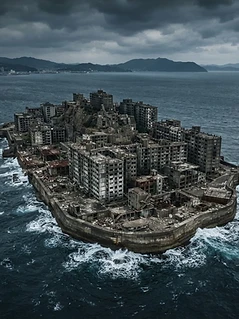
For eight days, we shall drift through Hashima, a stone leviathan shipwrecked in the immensity of the sea. Where thousands once breathed, only salt now inhabits the rooms, and the wind recites its elegy through eyeless windows. To photograph these ruins is to gather the ashes of modernity before the ocean erases its final dream. existed, now returned to silence and salt.
There is no place like Hashima.
A tiny reef off the coast of Nagasaki, it rose from the sea to become the most densely populated place on earth — a fortress of concrete where miners and their families lived stacked in high-rise blocks above the coal seams below. When the coal ran out, the island was abandoned in a single breath, and the sea and the wind began their slow reclamation. Today it sits in the water like a ghost ship, its apartment towers and stairways crumbling into the salt, and to photograph it is to stand inside a ruin that was once a city — and before that, nothing at all.
The Expedition
This expedition is an act of patience and permission. Hashima is not open to casual visitors; landing is restricted, the structures are fragile, and the weather of the East China Sea decides whether we go ashore at all. We have secured the rare authorisations that allow our small cohort to work on the island across several tides, accompanied by guides who know which walls still hold and which do not. We approach by boat from Nagasaki, and we photograph not only the ruins but the crossing itself — the moment the island resolves out of the haze and reveals its battleship silhouette, and the moment it vanishes again behind us on the return.
The Work
Our work here is documentary and contemplative in equal measure. We photograph the collapsed staircases, the corridors where the sea light falls through broken concrete, the rusted machinery of the mine, and the smaller human traces — a tiled bathhouse, a schoolroom open to the sky. And we photograph Nagasaki itself, the living city that faces the island, where the story continues in the memorials and the quiet harbour light. This is an expedition for photographers who understand that some places are not photographed to be made beautiful, but to be remembered.
§ The Itinerary
The Itinerary
Nagasaki — Arrival & Briefing
Arrive at Nagasaki Airport and transfer to our hotel in the old harbour quarter. Evening welcome dinner, master photographer briefing, and gear check. We review the tide and weather windows that will govern our landings on Hashima over the coming days.
Nagasaki — The Living City
A day photographing Nagasaki itself — the memorials, the harbour, and the quiet streets that face the sea. We begin to build the visual relationship between the living city and the abandoned island it sent into the water.
First Crossing — The Approach
We depart Nagasaki by chartered boat. The crossing is part of the work — we photograph the moment Hashima resolves from the haze, its battleship silhouette growing. First landing and orientation on the permitted viewing platform. Return before the tide turns.
Hashima — The Apartment Blocks
A full permitted day on the island. We work the residential towers — the stacked concrete apartments where thousands once lived, now open to the sky. Long exposures, wide interiors, and the falling light through broken walls.
Hashima — Corridors & Stairways
A second day ashore, focused on the vertical architecture — the collapsed staircases, the corridors where sea light cuts through, the rusted reinforcement exposed by decades of salt. We work slowly and carefully, respecting the fragility of the structures.
Hashima — The Mine & Machinery
Our final permitted day on the island. We photograph the industrial remains — the coal-handling structures, the rusted machinery, and the smaller human traces: a tiled bathhouse, a schoolroom returned to the elements. Afternoon return to Nagasaki and edit.
Nagasaki — Edit & Critique
A full day of editing and critique in our Nagasaki studio. We review the week's frames, build a coherent sequence, and prepare a group selection. Evening walk to photograph the harbour lights and the distant shape of the island from the shore.
Nagasaki — Farewell
Final group review and print selection. Farewell lunch. Transfer to Nagasaki Airport for afternoon departures, carrying the record of a place that few will ever see from inside.
§ Gear Requirements
Gear Requirements
- DSLR or mirrorless camera body (weather-sealed — salt spray is constant)
- Wide-angle lens (16–35mm or 14–24mm) for the tight corridors and tower interiors
- Standard zoom (24–70mm) for documentary and architectural detail
- A fast prime (35mm or 50mm f/1.4 or faster) for the dim interiors
- Sturdy tripod with ball head — essential for long exposures in low light
- Cable or remote shutter release
- Polarizing filter for the sea and harbour reflections
- Neutral density filters for long-exposure work on the crossing
- Lens cleaning kit — microfiber, blower, and sensor swabs (salt and dust are relentless)
- Extra batteries — cold sea air and long exposures drain them quickly
- Sufficient memory cards (64GB or larger recommended)
- Laptop with editing software for daily critique sessions
- External hard drive for backup of each day's work
- Headlamp with red light mode for early crossings and dim interiors
- Rain cover for camera and a dry bag for the boat crossings
- Gloves with grip for handling gear and steadying yourself on rough concrete
- Sturdy non-slip footwear — surfaces are wet, broken, and uneven
- Layered clothing with a windproof outer layer — the sea wind is cold even in November
§ The Light Map
The Light Map
In early November the sun rises near 06:50 and sets near 17:30.
Hashima faces south-west, so the island's apartment towers are side-lit in the morning and backlit at dusk — the best architectural detail emerges in the first two hours after sunrise, when low angle rakes across the concrete.
Interior corridors are dim throughout the day; shoot at f/2.8 or faster, tripod-mounted, with long exposures.
The boat crossing is best photographed in the hour after dawn or before sunset, when the sea carries colour and the island silhouette is strongest.
Nagasaki harbour lights come alive from 17:00 — photograph the distant shape of Hashima from the shore after dark, long exposure on a tripod.
Overcast days, common here, are not a loss — they give even, diffuse light that flatters the ruined concrete and suppresses harsh shadows in the corridors.
§ 04 — The Archive
Frames from Hashima (Gunkanjima) — Nagasaki, Japan
A selection of high-resolution frames captured on past expeditions. Select any image to view it full-size.