§ Workshop — Foundation
WHERE WATER REMEMBERS LIGHT
Venice, Italy
Departs · 01 March 2027 · 6 days
Participants · 6 · Spots remaining 6
Six days exploring Venice through the photographer’s gaze, following the uncertain boundary between what the city reveals and what it merely allows us to glimpse. A visual journey in which documentary observation meets poetic storytelling, and every image becomes both a record of a real place and, at the same time, of its apparition.
Venice will be more than the destination of the workshop: it will be its living material. We will walk through alleyways still immersed in the silence of morning, cross squares where time seems to have gathered at the foot of ancient façades, and sail towards the islands as the lagoon dissolves all sense of distance. We will follow the movement of water, the transformations of light, and the traces left by time on stone, wood, walls, and faces.
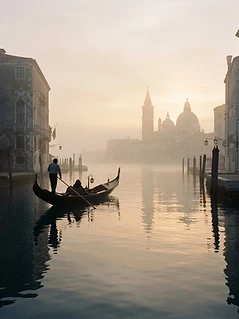
We will not seek the monumental Venice of postcards, motionless in its beauty and already reproduced countless times. Instead, we will search for a more secret, fragile, and unstable city: reflections broken by the passing of a boat, a figure disappearing into the mist, the tide line etched into the plaster, a window illuminated for a few fleeting moments, or the everyday gesture of someone who continues to inhabit a place suspended between splendour and erosion.
Photography will become an instrument of exploration, but also a form of listening. We will learn to wait for the light to reveal the invisible structure of a scene; to recognise the moment when an apparently ordinary detail acquires the weight of a symbol; and to observe how human presence enters into dialogue with a landscape shaped by water over the centuries. Every image will emerge from the meeting of precision, sensitivity, and time.
The workshop will embrace the approach of great photographic reportage: close attention to the territory, respect for its people, and the ability to transform direct experience into a coherent visual narrative. We will not simply collect isolated images. We will construct sequences capable of conveying the rhythm of the city, its contradictions, its silences, and the complex relationship between beauty, everyday life, and environmental fragility.
The lagoon will be observed as a living organism. The tides mark the rhythm of its breathing; the mist continually redraws its boundaries; the wind alters the colour of the water and the distance between things. Venice will emerge as the result of an ancient and precarious balance between nature and human ingenuity, permanence and transformation, memory and loss.
Each participant will be invited to develop a personal point of view. Some may follow the traces of everyday life, others the changing landscape, and others still the abstract forms created by the encounter between water, architecture, and light. Through field explorations, practical assignments, group reviews, and editing sessions, the photographs will gradually come together to form an individual narrative.
The result will not be a simple travel diary, but an intimate geography of Venice: a map shaped by moments of waiting, unexpected encounters, detours, and sudden revelations. A narrative in which what has been seen becomes intertwined with what has been imagined, and in which every photograph preserves something that, at the very moment it appears, already seems about to vanish.
Where Water Remembers Light is an invitation to photograph Venice not as a motionless image of the past, but as a living and vulnerable presence. To observe what endures, what changes, and what is at risk of disappearing. To allow the water—the city’s silent keeper—to guide our gaze and return to us, for a single moment, the memory of light.
What makes this experience truly exceptional
There are two Venices. The first is the city encountered on foot: the Venice of bridges, calli, campi and familiar views—the magnificent city seen by millions of visitors every year. The second is a more secret Venice: the city understood by Venetians, whose true streets are made of water and whose character reveals itself only from the lagoon and the intimate canals threading through its ancient heart.
Through its partnership with Venice Photographic Workshop, London Photographic Workshop can open this second city to our participants, offering a photographic experience that no conventional tour could reproduce.
At the heart of this partnership is Manta, an authentic Venetian working boat. After a lifetime of service, when she was destined to be dismantled and reduced to timber, Manta was rescued and returned to working life by a traditional Venetian boatyard. She was carefully transformed into a vessel designed specifically to carry photographers, assistants and professional equipment safely through the lagoon.
For two days, Manta will become our moving studio and privileged observation point. From her deck, close to the surface of the water, we will photograph Venice as a living maritime city: its façades rising directly from the canals, its reflections broken by passing boats, its working edges, its quiet waterways and the changing relationship between stone, light and tide.
Her size and character allow us to move through parts of the Venetian waterways rarely entered by ordinary tour boats. Water taxis travel for speed and destination; gondolas generally follow established routes. Manta was reborn for something entirely different: to give photographers the time, stability and freedom required to observe, wait and work from the water.
This is not simply Venice photographed from a boat. It is Venice understood through water—the element that built it, sustains it and continues to shape its memory.
§ Field Work
Field Work
The tide as author
In Venice the tide edits the city faster than the light does. It reveals a step, shifts the water's line against a wall, carries a reflection out of alignment with what sits above it. Read the tide table before the forecast: an image here can depend less on when the sun arrives than on the instant the water refuses to give the city back exactly as it stands.
Waiting for the invisible structure
Do not chase the monumental view — wait instead for the ordinary detail that acquires weight: a window lit for a few seconds, a tide line etched into old plaster, a figure dissolving into mist at the edge of visibility. The photograph is a form of listening before it is a form of looking.
The travel diary
Our age hands us machines and calls them memory. They are fast, and the journey is not. The journey asks for the opposite of speed: it asks for pauses, for halts, for the hours when the body rests and the mind catches up with where it has been.
Carry a notebook, and write in it by hand. There are moments on every journey when you find yourself alone, for an instant, before the immensity in front of you. It is then that thoughts arrive which will never come again, and which no screen will keep for you. Fix them on the page, or they scatter into the dust, the sun and the wind of the day, and are lost.
A gift of your own images
Most of the advice I can give you is obvious. Protect your equipment. Keep your socks and shirts away from the dust, because pulling on a clean, fresh shirt is always a pleasure. Any traveller knows these things, and perhaps you know them already. I say them not to teach, but because a teacher leads by example.
But there is one thing I have learned over the years that I do not impose on you: I recommend it, with force. If you wish to build a real relationship with the people you meet, a gesture of tenderness, a gift, is the surest way. Travellers have always carried gifts to the peoples and the strangers who received them. And what is the most precious gift a photographer can give? An image.
My suggestion is simple. Take one of those small photo albums, ten by fifteen, and fill it with the pictures you love most, printed small. Give them to the people you meet along the way. Write on them with a suitable pen: hello, your name, thank you, whatever you wish. The print becomes a personal object, made for that person alone. It costs you nothing, and it is an extraordinarily powerful gesture.
And it will raise you onto another scale as a human being. You will no longer be someone who arrives, takes an image and leaves. You will be someone who gives something back, who leaves a trace of gratitude instead of only carrying one away. The people before your lens feel that difference at once, and they meet you as a person, not as a camera. That is where the finest photographs are born, and something more than photographs: a bond.
§ The Light Map
The Light Map
At the beginning of March, Venice stands between seasons. Winter has not entirely released the stone, yet the day is lengthening. Light reaches farther into a courtyard; a reflection climbs a wall that was dark when we passed it earlier. The city asks us to return, not simply to move on.
Between 1 and 6 March, sunrise advances from approximately 06:50 to 06:41 and sunset moves from 17:57 to 18:04. These are local winter-clock times. Daylight grows from a little over eleven hours to almost eleven and a half, giving us more space to follow a subject without mistaking duration for urgency.
The moon wanes throughout the workshop, moving from the days after last quarter towards the new moon of 8 March, just beyond our dates. Its remaining light belongs increasingly to the hours before dawn. Evenings receive little moonlight, leaving the lagoon’s darkness, artificial light and reflected colour to establish their own balance.
March averages near Venice are around 5°C overnight and 13°C by day. Early mornings can be colder, with dampness and lagoon wind extending the feeling of winter. Mist, rain and clear intervals produce very different readings of distance: a façade can become a solid plane or almost disappear into the air.
Tide is a second measure of time. It reveals steps, changes the level of the water against buildings and carries reflections out of alignment. We follow those small displacements. A photograph may depend less on the arrival of sunlight than on the instant when water refuses to return the city exactly as it stands.
§ What You Will Learn
What You Will Learn
From a boat, a familiar façade loses the pavement that usually explains it. Water reaches the door; a reflection supplies another floor; the wake of a passing vessel breaks the building into fragments. Venice teaches us how readily a photograph can change the apparent stability of the world.
Seeing from the water
Aboard Manta, you will learn to anticipate the relationship between the boat’s movement and the composition. Shutter speed must account for both the subject and our own motion. We will work with a secure handheld technique, responsive focus and focal lengths that allow the image to develop as the viewpoint changes.
You will compare the low perspective of the water with the views encountered on foot. The purpose is to understand what each reveals about a city built around channels, working routes and thresholds reached by boat.
Reflections, mist and the colour of time
We will photograph reflected light on walls, water carrying broken images and the soft separation of forms in mist. Exposure decisions will preserve the atmosphere while retaining the details that give the scene its structure.
You will learn when a reflection is the subject, when it competes with what lies beneath it and how polarisation changes that relationship. On stable ground, we can explore longer exposures; from the boat, timing and camera stability ask for another method. White balance and tonal decisions will be considered through the colours of plaster, stone and water.
A city still being lived in
Venice contains work and habit alongside its extraordinary architecture. We will attend to people moving through their own day, waiting for a gesture or a crossing of paths to clarify the relationship between life and place.
You will practise approaching an encounter respectfully, selecting a distance that gives it context and recognising when to put the camera aside. The image should retain something of the person’s world rather than reducing them to a figure inside a composition.
An intimate geography
In our reviews, photographs made on foot and on water will begin to form a conversation. You may follow weather, everyday labour, traces of erosion or the abstract meeting of colour and reflection.
We will work on selection, sequence and accurate captions, distinguishing a recurring idea from an image we have simply made several times. The aim is a personal account of Venice whose rhythm comes from the city you actually encountered.
§ The Itinerary
The Itinerary
§ Phase 01
The first light
Venice before it becomes an image
An early walk through the quieter city introduces observation, timing and the visual relationship between water, architecture and human presence. The afternoon establishes each participant’s personal line of inquiry.
§ Phase 02
The inhabited city
Gesture, work and everyday passage
Documentary fieldwork follows residents, thresholds, markets and the subtle choreography of daily life. The emphasis is on respectful proximity and on recognising meaning before raising the camera.
§ Phase 03
The lagoon
Distance dissolved by water
A day shaped by vaporetto routes and selected lagoon islands. Water, weather and the changing separation between objects become the structure of a visual sequence.
§ Phase 04
Tide
The city’s other clock
We board our Manta (Venetian working boat) for the first of our two days on her deck. Close to the surface of the water, the field plan follows the measured tide and its effect on steps, quays, reflections and pedestrian movement. Manta reaches waterways closed to ordinary tour boats, and from her low, steady deck we work on repetition, variation and the transformation of familiar space.
§ Phase 05
Mist · winter light
What Venice allows us to glimpse
Our second day aboard Manta is weather-led, devoted to fragile visibility: fog, rain, reflected brightness or clear winter light. The route remains open so Manta can follow the condition that actually arrives, carrying us into canals no ordinary boat would attempt.
§ Phase 06
The sequence
Where Water Remembers Light
A final dawn session is followed by editing and sequencing. Each participant constructs an intimate geography of Venice in which observation, atmosphere and human trace form a coherent visual narrative.
§ Accommodation
Accommodation
Inhabiting Venice
Over the years, we have welcomed to Venice many groups of photographers: people already devoted to the city, as well as travellers encountering it for the first time. Each arrives with a different way of looking, and often with a different idea of how they wish to inhabit the city. For this reason, we always recommend discussing accommodation together before the workshop.
A place within the rhythm
We have a carefully considered proposal ready for the group, chosen for its position, comfort and relationship with the daily rhythm of Venice. Should you prefer to make your own arrangements, or should the group wish to explore something more distinctive, unusual or unconventional, we will be equally pleased to help. We have done so many times before, and will gladly help you find the place that feels right for your stay.
The final night
The additional night after the last working day is offered by London Photographic Workshop, allowing the final edit, farewell and departure to unfold without haste.
§ The Equipment
The Equipment
§ Photo Gear
Photo Gear
Venice is photographed on foot and from the water, in the damp of March, with a bag that must never touch the ground. Here is what the city does to equipment.
What the lagoon asks
The damp comes first: it settles on the front glass the moment you step from a warm room onto the fondamenta, and a lens can stay fogged for ten minutes. On the vaporetto, spray and diesel film the filter. The light is low and reflected, thrown back up by the water into the arcades, and the finest pictures of the week are made at shutter speeds no hand can hold. And there is no room: calli a metre wide, bridges full of people, a tripod that must open and close in a minute.
The list
Tripod
In Venice the tripod is not for the landscape: it is for time. On a tripod the lagoon becomes a mirror, the people crossing a bridge become a breath, and the camera stays still while we look at the same frame together and talk about it. Choose one that is light and quick: on a bridge you have one minute before someone needs to pass.
The bag
A shoulder bag, carried in front, never a rucksack: on the vaporetto and in the crowd, whatever is behind you is no longer yours. It must close completely, because in March the rain comes without warning.
What we bring for you
There are a few wonders in our bags for you, too. Medium format cameras to pick up and use, including the splendid HASSELBLAD X2D II 100C. A complete set of LEE filters with matte boxes, SEKONIC light and colour meters, a COLORCHECKER.
And then there is Luca, your guide: a true fine art photographer — read: a rather unusual photographer. Do not be surprised if view cameras, ultra-panoramic film cameras and other delightful oddities emerge from his bags. Shh… they are part of the experience, too.
Need a backup camera, a particular lens, a tripod, a head or a monopod? Tell us before departure so we can plan what to bring. Our enthusiasm is considerable. Our carrying capacity has its limits.
§ Personal Gear
Personal Gear
Venice is walked. Stone, bridges and steps, in the damp cold of the lagoon. What you wear decides how much attention you still have left for the photographs.
Over the years, we have developed a welcome package to make your stay as comfortable as possible. It brings together the things that are easily forgotten, or difficult to arrange from abroad.
§ Travel Conditions
Travel Conditions
Venice is one of the world’s great international destinations: well connected, widely known, and endlessly documented. There is little to explain that visitors do not already expect. What matters is simply to arrive prepared to walk slowly, travel by water, and accept the city’s rhythm: a place shaped by tides, crowds, detours, weather, and the changing density of light.
If you choose to arrive at an airport other than Venice, but still within easy reach, there is no need to worry. We can collect you directly, or provide all the information you need to join us independently. Should you require any guidance or assistance in planning your journey to join us, we would be delighted to hear from you.
§ Safety & Accessibility
Safety & Accessibility
Venice welcomes the world, yet moves to a rhythm of its own. In the historic centre there are no cars: we walk through narrow lanes and squares, up and down the bridges, or travel aboard the vaporetti. Walking, waiting and boarding all take time, and that time is part of the work. Luggage travels over the bridges by hand, which is the real reason we ask you to come light.
We always work in pairs, and this is the heart of the method. The photographer inside the viewfinder stops seeing everything else: the bag left on the ground, the person arriving from behind, the edge where the stone ends and the water begins. So the one who is not photographing is not resting. They watch the equipment, their own and their partner's, and they watch the situation. One of you looks into the frame. The other looks after everything else.
Part of the work happens on the water, and the whole group goes aboard together. This is not a sightseeing tour: it is a photographic one. Where the tourist boats keep moving, we take every chance to stop, to come alongside, to slow right down. Our boatman is used to working with photographers: he knows the traffic of the lagoon and the Grand Canal, and he knows where a boat can hold still. With everyone aboard, movement is a shared matter: move slowly and deliberately, without crowding the person beside you and without throwing the boat off balance. It is not a small boat, but it is a boat, and it is on water. Getting on and off is the moment that matters: let the boatman help you, take the time you need, and never hurry.
March is cold, damp and often windy off the lagoon. Stone becomes slippery with rain, fog and the algae on the steps that descend into the canals, and those steps are where people actually fall. Many fondamenta have no parapet: a tripod set close to the edge, at first light or after sunset, is a decision that concerns the pair, not the individual. High water is ordinary in this season. Tide forecasts are checked the evening before, walkways appear in the lower squares, and when the water rises the plan changes location rather than forcing it.
Tripods are restricted in some areas and under certain arcades, and drones are not permitted. We will tell you where and when each of these applies.
Bridges are steps, and steps are barriers. If you have specific mobility needs, speak to us before booking and we will review the route together, with the accessible alternatives the city allows.
§ Post-Workshop
Post-Workshop
After leaving Venice, where water, mist and the inhabited city had made each image a record of an apparition, the images need the companions who walked that fragile geography together.
I did not include six months of post-workshop contact by chance, nor as a simple service.
Many years ago, I was teaching an online course that could easily have felt impersonal. Instead, when it ended, the group did not want to dissolve. We had never all sat around the same table, yet years later we are still a living community. From that experience came conversations, magazines, books, friendships and shared ways of looking.
It taught me how valuable a small circle of people can be when they have lived and worked through an experience together.
For this reason, every workshop includes six months of continued contact at no additional cost, and those months are where the photographs are carried to their end, together. A private group keeps the images moving between us: feedback, and a tuition that goes on, fed by cultural prompts — a book, an image, a thought, an exhibition, an occasion that opens a new direction. Each of you brings your images to a master file ready for fine print, and then we sit down, one to one, before the finished work. Then the group meets again, and there is a particular pleasure in it: seeing how far each of us has travelled since we parted. A Second Eye, an editor or a curator, reads the work as the profession reads it. And the work takes form, a collective book or a zine, depending on the event, and a public life, on a gallery wall or in the pages of Follow the Light. The images do not go back into a drawer. They go out into the world, and they go out together.
The event ends. The adventure in photography begins.