§ 32° 36' N, 129° 42' E — Travel
THE BATTLE ISLAND
Gunkanjima — Nagasaki, Japan
Departs · 30 April 2027 · 8 days
SOLD OUT
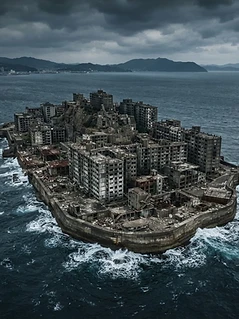
Hashima — Gunkanjima, the “battleship island” — stands off Nagasaki as a dense fragment of industrial memory. Once built around coal, it held thousands of people inside a compressed world of concrete apartments, stairways, sea walls and machinery. Today the island is uninhabited, exposed to salt, weather and slow collapse.
Over eight days, we approach it not as a ruin to consume, but as a place that asks for patience, distance and ethical attention. Photography here is a way of reading surfaces: the marks of work, domestic life, abandonment and time. The journey develops a visual language for architecture, silence and the difficult presence of a place whose history cannot be reduced to an image.
§ 01
Where the sea keeps what the world has abandoned
Some places enter our lives before we have ever seen them.
Hashima does this to me. Long before I first approached its sea walls, it awakened the memory of another abandoned industrial place, close to the city where I was born. I was young when I began going there with a camera. The factory had fallen silent, but it was still filled with the remains of work: shelves, damaged furniture, forgotten objects, dust, chemical residues, rooms slowly surrendering to weather and time.
Over the years, I began to care for a small part of it. I cleared away what was dangerous, lifted objects from the floor, returned fallen things to their shelves and gathered broken furniture into a store room. In the few spaces that could still be inhabited, I created order. It was never a studio in the conventional sense; it became something more private and more necessary — a place in which I felt at ease, a place I could listen to, and the place where I truly learned to photograph.
That factory no longer exists. I cannot return to it.
And yet, when Hashima rises from the water, I feel that an old door has opened again. Not because the two places are the same — their histories are not interchangeable, and Hashima carries suffering that must never be absorbed into my own nostalgia — but because both ask the same essential question of photography: how do we enter a place altered by labour, abandonment and time without merely taking from it?
The answer begins with care.
We approach Hashima slowly, by sea. At first it is a dark line on the horizon; then a wall; then an impossible concentration of concrete, windows, stairways, roofs and voids. From a distance it resembles a battleship. Closer, it ceases to be an icon and becomes a complex body: natural rock enclosed by reclaimed land, a coal mine built above shafts descending beneath the sea, and a city compressed around the machinery that sustained it.
We are not going there to collect photographs of decay. We are going to work with distance and proximity, evidence and imagination, beauty and responsibility. We will photograph the island as architecture, landscape and archive: the violence of salt against concrete; the geometry of sea walls; rooms exposed to weather; the traces of domestic life beside the structures of extraction; and the uneasy silence that follows a place once filled with thousands of human voices.
This is not a journey governed by a rigid script. The sea will decide part of our rhythm. Light, weather, permissions and the condition of the island will decide another part. I have led this expedition three times, and I know that no two encounters with Hashima are identical. We will work with a precise structure, but we will also remain attentive enough to change it when the place asks something different of us.
For me, that flexibility is not a lack of organisation. It is the discipline of a real photographic production. If you need every hour to remain untouched by weather, discovery or conversation, this may not be the journey for you. But if you understand photography as a way of being present — intellectually, physically and emotionally — then Hashima can become far more than a destination. It can become a measure of the way you look.
§ 02
The photographic work
Our purpose is not to return with a collection of isolated trophies, but to build a body of work. We will think in sequences: the departure from Nagasaki, the passage across the water, the first appearance of the island, its outer defences, the points at which access becomes possible and the places that remain unreachable. The photographs will not be asked to explain everything. They will be asked to observe precisely, to leave room for doubt and to recognise what an image cannot know on its own.
The group will work as a small production team. We will share practical decisions, compare approaches and return repeatedly to the relationship between form and meaning. A wall can be photographed as abstraction, engineering, protection or confinement. An empty window can become atmosphere, but it can also become evidence of a room once inhabited. The difference lies not only in framing; it lies in knowledge, intention and the sequence in which the image is placed.
I will work beside you in the field and remain available as the project develops: helping you edit, question repetition, recognise the beginnings of a visual language and resist the most obvious photograph when the island offers something more difficult and more truthful.
§ 03
Hashima
Rock, coal, concrete and sea
Hashima is neither entirely natural nor simply artificial. It began as a small rocky outcrop above a submarine coalfield, southwest of Nagasaki. After Mitsubishi acquired the mine in 1890, successive reclamations enlarged the island and sea walls enclosed it against some of the region's most demanding waters. By the twentieth century, a natural core had become the centre of a densely engineered industrial settlement approximately 480 metres long and 160 metres wide.
Below the island, mining galleries extended beneath the seabed. Above them, an extraordinary concentration of housing, workshops, offices, a school, medical facilities and communal spaces supported a population tied to the mine. Industry did not merely occupy Hashima: it produced its outline, determined its density and organised the lives lived within its walls. When the mine closed in 1974, the inhabitants left, and a functioning town became an uninhabited structure exposed to salt, typhoons and time.
The familiar nickname Gunkanjima — Battleship Island — comes from this constructed silhouette. It is compelling, but it can also flatten the place into a single dramatic image. Our task is to move beyond the silhouette and read the island as a series of layers: geological, industrial, domestic, colonial, wartime and memorial.
§ 04
Labour, coercion and the responsibility of memory
Hashima must not be presented as an empty ruin waiting for photographers. It was a Mitsubishi coal mine, a company town and a place shaped by the larger history of Japanese industrialisation. It was also marked by the colonial and wartime mobilisation of labour.
During the war, Korean and Chinese workers were brought into Japan's industrial system under different forms of recruitment, mobilisation and coercion. UNESCO documentation concerning the industrial heritage sites requires recognition that many Koreans and others were brought against their will and forced to work under harsh conditions during the 1940s. Hashima belongs within that difficult history.
Precision matters here. The available authoritative documentation does not justify describing Hashima generically as a prisoner-of-war camp. Refusing that inaccurate label does not diminish the violence of forced labour; it prevents suffering from being turned into a vague dramatic device. We will speak instead of what can be supported: a mining site connected to the coercive mobilisation and forced labour of Korean and Chinese workers, within the colonial and wartime structures of Imperial Japan.
The island also held Japanese families, children, schools and the routines of an intensely crowded community. These histories do not cancel one another. To acknowledge domestic life is not to erase coercion; to acknowledge forced labour is not to pretend that every person on Hashima lived the same life. The responsibility of the photographer is to resist a simple story when the place itself contains many.
Before approaching the island, we will make time for a historical briefing. We will look at what is documented, distinguish fact from interpretation and consider the language with which images might later be presented. We will ask what we are truly seeing, what we know from a source, what cannot be deduced from appearance, and what history must accompany the photograph.
Here, beauty does not release us from responsibility. The camera must not extract once again from a place already organised around extraction. Our photographs can hold structure, atmosphere, distance and loss — but they must do so without turning labour or suffering into spectacle.
§ 05
Unzen
Unless You Would Like to Go to Hell?
We mean Unzen. But I thought I should ask.
There is another possible beginning to this journey: not on the sea, but above the heat of the earth. Unzen Jigoku — the "hells" of Unzen — is a geothermal field where steam rises through pale mineral ground, sulphur enters the air and the landscape appears to breathe beneath the feet. In 1934, Unzen was designated as one of Japan's first national parks; today it forms part of Unzen-Amakusa National Park.
The place is visually extraordinary, but it is not a theatrical prelude. Its fumaroles, hot ground, altered earth and mountain vegetation belong to a living geological system. Unzen also carries the grave memory of the persecution of Christians during the Edo period. We will therefore photograph it as we photograph Hashima: with curiosity, but without turning history into scenery.
If the group chooses this opening, we will spend the first night at Yuyado Unzen Shinyu, a traditional ryokan with natural hot springs. After dinner and the long quiet of the baths, we will begin the following morning among steam, mineral deposits, timber walkways and the changing visibility of the mountain air. We will then travel to Nagasaki and continue the expedition from our main base at Nisshokan Bettei Koyotei.
Unzen changes the first movement of the journey. It replaces part of our initial city photography with something more elemental: first the subterranean force of volcanic ground, then the industrial history drawn from beneath the sea. One landscape is still active; the other has fallen silent. Between them lies Nagasaki, and the human histories through which both places must be understood.
This optional beginning will be decided with the group. If you would like to go to hell, tell us when you book.
§ 06
A final note on the journey
The programme, permissions, safety arrangements and responsibilities of the workshop are governed by clear agreements. But an agreement alone cannot create the eight days we will share. Those days will also be made from conversation, meals, changing weather, cultural exchange, concentration, fatigue, humour and the generosity with which a group learns to look together.
That human dimension matters to me. It is why I prefer a small group, why I care about where we return after the island, why food and the table belong to the experience, and why the conversation continues after the cameras have been put away.
Hashima reminds me where I learned to photograph. I cannot return to that first abandoned factory, but I can return to the question it gave me: whether entering a place with a camera can also be an act of attention, order and care.
This journey is my answer — and an invitation to discover your own.
§ What You Will Learn
What You Will Learn
An empty window tells us that there was a room. It cannot tell us who lived there, what they endured or why they left. On Hashima, we will work within that distance between visible evidence and the history a photograph needs beside it.
Photographing the approach
The island first appears across water. You will learn to use that approach as part of the story, considering how the silhouette changes into separate structures as the distance closes. From a moving boat, shutter speed, camera support and responsive focus will help preserve the detail you intend to describe.
We will compare broad views with tighter observations of the sea walls and buildings, using focal length to isolate relationships without losing their geographical context.
Concrete, salt and the space between buildings
Once within the accessible areas, you will work with overlapping forms, exposed surfaces and the intervals through which the island can be read. Camera height and alignment will matter as much as the lens: a small movement can separate a doorway from the structure behind it or turn an unreadable mass into a clear arrangement of spaces.
We will study exposure in bright marine light and deep architectural shadow, control flare and pay attention to moisture on the front element. Where a tripod is practical, it will support deliberate focus and composition. In other situations, we will adapt the method while keeping the intention precise.
Evidence and interpretation
You will learn to distinguish what the frame records from what you bring to it through research or personal memory. We will keep notes and captions alongside the photographs, examining whether a sequence makes a historical claim its images cannot support.
An abstract study of concrete can have a place in the work, as can a view of domestic structures or the relationship between industry and sea. The edit will determine how these different readings coexist without reducing the island to a single mood.
Making a body of work
Our reviews will follow the passage from Nagasaki to the island and back, including the places we can see only from a distance. You will practise removing repetitive images, varying the scale of observation and allowing an unanswered question to remain within a sequence.
If the optional Unzen opening forms part of the journey, steam and changing visibility will introduce another exercise in exposure, timing and the limits of description. Throughout, the aim is a personal photographic account that can hold atmosphere and exactness together.
§ The Itinerary
The Itinerary
Nagasaki — arrival & briefing
Arrive at Nagasaki Airport and transfer to our hotel in the old harbour quarter. Evening welcome dinner, master photographer briefing, and gear check. We review the tide and weather windows that will govern our landings on Hashima over the coming days.
Nagasaki — the living city
A day photographing Nagasaki itself — the memorials, the harbour, and the quiet streets that face the sea. We begin to build the visual relationship between the living city and the abandoned island it sent into the water.
First crossing — the approach
We depart Nagasaki by chartered boat. The crossing is part of the work — we photograph the moment Hashima resolves from the haze, its battleship silhouette growing. First landing and orientation on the permitted viewing platform. Return before the tide turns.
Hashima — the apartment blocks
A full permitted day on the island. We work the residential towers — the stacked concrete apartments where thousands once lived, now open to the sky. Long exposures, wide interiors, and the falling light through broken walls.
Hashima — corridors & stairways
A second day ashore, focused on the vertical architecture — the collapsed staircases, the corridors where sea light cuts through, the rusted reinforcement exposed by decades of salt. We work slowly and carefully, respecting the fragility of the structures.
Hashima — the mine & machinery
Our final permitted day on the island. We photograph the industrial remains — the coal-handling structures, the rusted machinery, and the smaller human traces: a tiled bathhouse, a schoolroom returned to the elements. Afternoon return to Nagasaki and edit.
Nagasaki — edit & critique
A full day of editing and critique in our Nagasaki studio. We review the week's frames, build a coherent sequence, and prepare a group selection. Evening walk to photograph the harbour lights and the distant shape of the island from the shore.
Nagasaki — farewell
Final group review and print selection. Farewell lunch. Transfer to Nagasaki Airport for afternoon departures, carrying the record of a place that few will ever see from inside.
§ The Route
The Route
§ 06
Accommodation
I have led this adventure three times, and each group has found its own way of living it. For a photographic production like this, where the sea, the work and the people shape our days together, I prefer to begin with a considered proposal and leave room for the group to make it their own.
My suggested base is Nisshokan Bettei Koyotei, a traditional ryokan on the hillside above Nagasaki. After hours among salt, weather and abandoned concrete, I know few pleasures greater than returning to a Japanese bath, changing for dinner and sitting down together. Koyotei offers Japanese rooms and traditional bathing, with access to additional baths at its neighbouring sister property. These are heated Japanese baths, rather than natural hot springs.
Our first and last dinners in Nagasaki will be at Sakamotoya, the historic house where Shippoku cuisine brings the city's Japanese, Chinese and European influences to a shared table. On the other evenings, we will dine at the ryokan.
Each morning, we will travel together from the hotel to the harbour in an executive van, which will also serve our planned transfers between accommodation and restaurants. The crossing from Nagasaki to Hashima takes approximately forty minutes each way, depending on our vessel, departure point and sea conditions. My preference is to return to the mainland after our photographic sessions, including any evening work arranged within the expedition.
Hashima has no toilets; our facilities during the boat-and-island days will be aboard the vessel. We will organise packed lunches after discussing everyone's dietary requirements and preferences, and bring them aboard before departure.
I am Italian, and food is part of how I welcome people. Having lived in Japan, I will take particular pleasure in shopping for the group: choosing Japanese things for you to taste, finding a few Italian favourites if I can, and keeping the boat's galley supplied with water and something good to eat during our working days. A shared lunch, a small discovery at the supermarket, something passed around after a demanding session — these are pleasures I look forward to as much as the conversations around our photographs.
We will spend eight days together. Alongside the work, there will be time for meals, cultural exchange and the simple enjoyment of one another's company. The accommodation proposed here gives us a comfortable base; we can discuss it as a group and, where arrangements allow, choose a different way of staying.
Unless you'd like to go to hell?
We mean Unzen. But we thought we should ask.
We could begin there, quite literally: at Unzen Jigoku, the “hells” of Unzen, where steam rises through pale mineral earth, sulphur scents the air and the ground reveals its heat. Unzen was designated among Japan's first national parks in 1934.
As an optional beginning, we may spend our first night at Yuyado Unzen Shinyu, a traditional ryokan with its own natural hot springs, approximately an hour and twenty minutes by road from Nagasaki. Dinner, a long bath, and the following morning among the fumaroles with our cameras.
We would then continue to Nagasaki and Koyotei, replacing part of the scheduled city photography on day two. Our first dinner at Sakamotoya would become our welcome to Nagasaki; the closing dinner would remain at the end of the journey. A different beginning, to be chosen together.
If the idea appeals to you, let us know when you first book: we can discuss beginning the journey with a night among the hot springs and a photographic visit to the volcanic “hells” of Unzen.
§ Photo Gear
Photo Gear
The sea decides the first instrument before the island is even visible. An approach made entirely of horizon has no use for a frame built to isolate a subject from its surroundings — it asks to be held wide, low, continuous, the way the water itself is continuous. A panoramic body earns its place in the bag before any zoom does: the crossing itself is already panoramic, and the camera only follows what the sea has composed.
Once ashore, the horizon closes and the scale inverts. A tower six storeys high, corridors that run the length of a collapsed street — none of this fits inside an ordinary negative without asking it to lie about its own size. Large format exists for exactly this problem: monumentality demands a print as monumental as the ruin.
What Hashima breaks, it breaks quickly. Salt does not wait to be noticed — this is not sand, which at least buries what it ruins; this is corrosion, invisible while it works. Against it, the camera travels sealed: a Ziploc bag closed with a BongoTie around the barrel while it shoots, the bag itself carried emptied of its padding, a Domke worn close to the body rather than held at arm's length.
A tripod at this scale is not a convenience; it is the only way the eye can hold still long enough for the ruin to be read rather than glimpsed. Beside it, a monopod with a small video assist becomes the arm that reaches where the body cannot follow — past a stairwell too fragile to climb, into a room the group can see without entering it.
What we carry for everyone: a second body, sealed and ready, for the moment a first one meets the deck the wrong way; a spare tripod leg; batteries that outlast a cold sea wind; enough of everything that one person's misfortune does not become the whole group's lost afternoon.
What each of us decides for ourselves: a view camera already known, if one is already known; film, if film is the eye one already has for salt, concrete and silence. Hashima does not care which instrument arrives. It asks only that whoever holds it has already decided what kind of distance they intend to keep.
What the crossing asks for
- Hasselblad X-Pan or equivalent 35mm panoramic body
- Medium-format panoramic — Fuji GX617-type, or Horseman/Linhof view camera with 6×9/6×12 roll back
- Standard digital body, 24–70mm zoom, for the boat and low light
- 35mm body for the quick frame
What the island's scale demands
- Large-format view camera with an ultra-wide-angle lens
- Ultra-wide zooms (16–20mm / 16–24mm / 14–20mm) or fixed ultra-wides (20mm / 18mm / 16mm / 14mm)
- Manfrotto 055 carbon tripod, feet protected against wet concrete
- Monopod with video assist and remote release, for stairwells and railings the body can't reach
What protects it from salt and concrete
- Domke bag, emptied of padding, worn close on the short strap
- Ziploc bags + BongoTies, sealed around each body while shooting
- Silver emergency blanket, one for the bag, one for you
- LEE matte box on every lens
What each photographer decides
- A view camera or panoramic back already known
- Colour or black-and-white film, if that's the eye you already have
§ Personal Gear
Personal Gear
Eight days between Nagasaki and the sea, with boat crossings, wet concrete and salt wind. Pack for the water as much as for the island.
Hashima is approached by sea, and the sea decides. Crossings can be rough, the quays are wet, the wind off the water is cold even in spring, and between the island and the harbour there is a whole city of steep streets to walk. Pack for the boat first; the island will take care of the rest.
What you bring
What we buy together
What we bring for you
Everything else travels with us in a waterproof dry bag: a local SIM card, and a loan phone if needed; a Starlink satellite connection; a walkie-talkie; a first-aid kit; a satellite locator beacon and an emergency flare, for the crossings and the days around the island; a compass, a map case and printed maps; a tablet for every two people; a little local currency; a laminated emergency sheet; a compact phrasebook; document pouches; and your own printed copy of our unique guide.
§ The Light Map
The Light Map
At the turn of May, Hashima does not appear all at once.
It emerges from the sea as a dark concentration of concrete, distance and weather: sometimes hard against a clear horizon, sometimes reduced by haze, spray and low cloud to an uncertain shape at the edge of the bay. The photograph begins before the landing, in the gradual movement from Nagasaki's living harbour towards an island that seems to have been left outside ordinary time.
This is not a light that asks for spectacle.
It asks for attention to tone, scale and the shifting relation between the island, the water and the sky.
Across the sea walls, the stacked apartment blocks, broken windows and exposed concrete, the same day may offer entirely different conditions. Morning can make the silhouette precise against the eastern light; later, warmer side-light can begin to reveal depth in the towers and sea-facing structures. Cloud, salt haze and wind may soften the distance until the island becomes almost monochrome. A break in the weather can bring sudden clarity, then take it away again.
We will work with this changing light rather than waiting for an ideal one.
The boat crossings, the approach to the pier and the time around the island are part of the photographic rhythm. When a landing is safe and authorised, the work continues on land within the permitted areas and the conditions set for the production. When the sea does not allow it, the water remains a place of work: a slower circumnavigation, carefully chosen stops, the architecture seen from its maritime distance, and time to build a sequence rather than pursue a single image.
There will be no obligation to force every hour of light.
There will be time to wait, to return to Nagasaki, to edit, and to understand what the sea and the weather have made possible.
The programme is built around attention, not prediction.
THE BATTLE ISLAND takes place from 30 April to 7 May 2027. Across those days in Nagasaki, the Sun rises progressively earlier, from 05:35 on 30 April to 05:28 on 7 May, and sets between 19:00 and 19:06. Its rising point moves further towards the north-east, while sunset shifts further towards the west-north-west. These changing late-spring angles give the harbour and the island a different balance each day, especially during the first and final hours of daylight.
The Moon moves towards darkness across the journey. At the beginning it is waning, just past last quarter, and rises only after midnight: on 30 April at 01:57. New moon falls on 6 May, and on the final evening a very young crescent appears briefly in the west, setting at 20:12. The evenings are therefore dark, and moonlight is not the basis of a promised nocturnal programme.
Early May in Nagasaki is mild and humid, commonly around 15–23 °C, with rain possible on any day before the rainy season of June. Sea wind can make the crossing and the island feel noticeably cooler than the harbour; the state of the sea, more than the temperature, decides each day. These are seasonal ranges, not a forecast.
The work is shaped above all by the available daylight, the state of the sea, the authorisation and the conditions of the day. At Hashima, the most memorable light may not be the light imagined before leaving home. It may arrive in a veil of rain, in the blue interval after sunset, in a sudden clearing over the water, or in the moment the island disappears again into weather.
§ Safety & Accessibility
Safety & Accessibility
Landing conditions
Landing on Hashima is never automatic. We hold this experience in spring, when weather and sea conditions are generally at their most favourable; nevertheless, the sea retains the final word.
Wind direction, wave height and the movement of the boat must be compatible with a safe approach to the island's pier. At times, this may require a long wait. The decision to land rests exclusively with the captain, an experienced professional with a deep knowledge of the route and of Hashima's particular landing conditions.
Should landing be temporarily impossible, the waiting time becomes part of the photographic work. We will make a slow, considered circumnavigation of the island, with a series of prepared and carefully chosen stops. From the water, participants will have time to construct a sequence of powerful views: the vast concrete profile of Hashima, its broken architecture, its sea walls, its silence, and its shifting relation with the open sea.
Sea sickness
Nagasaki Bay is known for wind and changing sea conditions. Even people who do not usually suffer from motion sickness may experience nausea during the crossing or while waiting near the island.
If you are prone to sea sickness—or are unsure how you will respond to the journey—we strongly recommend taking suitable motion-sickness medication before each boat departure. Such medication is widely available in Japanese pharmacies. Please ask a pharmacist for advice, particularly if you take other medication or have a medical condition, and follow the instructions provided with the product.
Accessibility & physical requirements
The journey to Hashima involves embarking from a boat, disembarking at the island's pier and working outdoors in an exposed maritime environment. Depending on conditions, participants may encounter stairs, uneven surfaces, wind, spray and extended periods at sea.
For these reasons, the workshop may not be suitable for every mobility or health requirement. Participants with reduced mobility, balance difficulties, respiratory conditions, sensory needs, or other access requirements are warmly invited to contact us before booking. We will consider each situation with honesty, discretion and care, while respecting the realities of the island and the safety decisions made on the day.
Protective equipment and safety conduct
Hashima is not a controlled studio environment. It is an abandoned industrial site continuously exposed to salt, weather and structural deterioration. Safety is therefore not separate from our photographic practice: it is the condition that makes the work possible.
Each morning, during the crossing to the island, we will hold a safety briefing based on the day's conditions and planned activity. The first briefing will also provide full instruction in the correct use of the protective equipment and in the procedures that will govern our work throughout the expedition.
Once ashore, we will move as a group or in working pairs. No participant may leave the group, enter a different area or undertake an independent exploration without informing the tutor and receiving approval beforehand. These instructions are mandatory and apply to everyone, without exception.
Protective equipment will be provided, including a safety helmet with a mounted light, protective work boots, gloves, a high-visibility jacket, a safety line and an emergency signalling light. A first-aid kit will remain available, and each working pair will receive a radio.
Participants must bring at least three complete changes of durable working clothes suitable for dusty, damp and physically demanding industrial conditions. Safety instructions are not optional: on Hashima, care for the group must always come before the photograph.
§ Travel Conditions
Travel Conditions
Exceptional access
Hashima is not an open photographic location. Ordinary commercial tours are restricted to a protected visitor route, while the island's abandoned buildings and the vast majority of its ruins remain inaccessible.
The work undertaken during The Battle Island — Hashima is possible through a special permit granted by the Nagasaki Prefecture following a highly complex authorisation procedure. This permission allows our photographic production to land on the island legally and to work beyond the limits of an ordinary commercial visit, always within the precise conditions established for the protection and safety of Hashima.
This is not urban exploration. It is a carefully prepared photographic production in an exceptionally fragile historical place. Every participant works as part of the group, follows the direction of the workshop leader and crew, and respects without exception the limits set by the authorisation.
§ After the Journey
After the Journey
After leaving Hashima for Nagasaki, with salt wind and the island's broken rooms still working in the eye, the images ask to be returned to the small group that faced that silence together.
I did not include six months of post-workshop contact by chance, nor as a simple service.
Many years ago, I was teaching an online course that could easily have felt impersonal. Instead, when it ended, the group did not want to dissolve. We had never all sat around the same table, yet years later we are still a living community. From that experience came conversations, magazines, books, friendships and shared ways of looking.
It taught me how valuable a small circle of people can be when they have lived and worked through an experience together.
For this reason, every journey includes six months of continued contact at no additional cost, and those months are where the photographs are carried to their end, together. A private group keeps the images moving between us: feedback, and a tuition that goes on, fed by cultural prompts — a book, an image, a thought, an exhibition, an occasion that opens a new direction. Each of you brings your images to a master file ready for fine print, and then we sit down, one to one, before the finished work. Then the group meets again, and there is a particular pleasure in it: seeing how far each of us has travelled since we parted. A Second Eye, an editor or a curator, reads the work as the profession reads it. And the work takes form, a collective book or a zine, depending on the event, and a public life, on a gallery wall or in the pages of Follow the Light. The images do not go back into a drawer. They go out into the world, and they go out together.
The event ends. The adventure in photography begins.
§ 04 — The Archive
Frames from Gunkanjima — Nagasaki, Japan
A selection of high-resolution frames captured on past expeditions. Select any image to view it full-size.