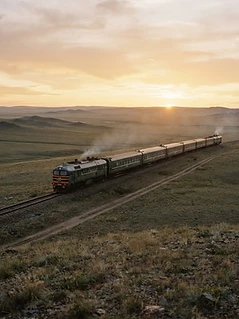
§ 8,500 km · 3 countries · 5 time zones — Expedition
EASTWARD, WHERE THE WORLD CHANGES ALPHABET
Russia — Mongolia — China
Departs · 07 April 2027 · 35 days
SOLD OUT
From St Petersburg to Beijing, by way of Siberia and Mongolia, this thirty-five-day railway expedition crosses landscapes that change not only in scale but in alphabet, rhythm and idea. Water gives way to industry, forest to steppe, long horizons to the dense human energy of the final city.
We do not travel to collect places. We pass through them attentively: sleeping compartments, stations, roadside meals, waiting rooms and long windows become part of the photographic work. Each territory brings a different question — water, ideology, distance, emptiness, density — and each participant develops a personal sequence through observation, conversation and daily editing.
§ 01
The route
Twelve stops, enough to see, not enough to tame: St Petersburg, Moscow, Suzdal and the Nerl, Kazan and Sviyazhsk, Yekaterinburg, Krasnoyarsk, Irkutsk and Olkhon, the Circum-Baikal and Ulan-Ude, Ulaanbaatar and the steppe of Hustai, the Gobi, Datong, Beijing and the Great Wall. The remaining nights belong to the train: the corridor becomes road, studio, and darkroom of the mind.
§ 02
Visual grammar
Five landscapes, five rules. Water (St Petersburg, the Nerl, the Volga): reflections, rain, surfaces; expose for the highlights. Iron (Urals): lines, masses, ideology; seek their friction with the everyday. Scale (Siberia): compress with an 85 mm lens; let distance become the subject. Emptiness (Mongolia): fewer images, more waiting; the horizon need not always sit in the centre. Density (Beijing): build layers; one clear gesture within the chaos.
§ 03
Teaching programme
The workshop advances by subtraction. Week 1: Seeing — exposure, previsualisation, walking rhythm, notebook, short sequence. Week 2: Constructing — geometry, planes, figure–ground relationships, colour as structure. Week 3: Encountering — consensual portraiture, listening, captions, giving back. Weeks 4 and 5: Sequencing — editing, diptych, rhythm, text, project coherence. Every evening: 20 minutes of contact sheets, 20 of selection, 20 of words.
§ 04
Exercises on the train
The sleeping compartment is a school of attention. Window: the equivalent of 36 exposures; one horizon height only. Corridor: tell time through five details, without photographing the landscape. Stations: one image per stop; work only during the permitted minutes. Compartment: a still life of fellow travellers; ask, show, write down the name. Night: 1/15 sec, high ISO; photograph movement, not digital noise.
§ 05
Daily method
Photograph, name, lose, rediscover. Dawn: 90 min in the field, no reviewing on the display for the first 30 min. Midday: A/B backup, notes on names, places, and consent. Sunset: second outing, variation not repetition. Evening: contact sheet from 60 to 12 to 3 images; one sentence for each. Every 4 days: group critique — intention / form / ethics / next move.
§ 06
Borders and reality
Poetry begins after passport control. Visas: check Russia, Mongolia, and China through consular sources before purchase. Photography: never photograph borders, military, police, sensitive installations, or others' documents. Trains: the route must be ticketed in segments. Connections: the Irkutsk–Ulaanbaatar and Ulaanbaatar–Beijing services run only once or twice a week — the whole calendar is built around these two departures. Plan B: keep a 48-hour buffer and carry insurance with medical and evacuation cover.
§ 07
Booking
First the two international bridges, then everything else. T-120: secure visas and insurance; British, American, Canadian, Australian and New Zealand passports need a traditional Russian visa, not the eVisa. T-90: Russian domestic tickets go on sale; issue them the day sales open. T-60: the international trains go on sale — the train to Ulaanbaatar, joined at Ulan-Ude, and the Thursday train to Beijing, joined at Sainshand in the Gobi. Book the Mongolian host and fixer. T-30: reconfirm timetables, registrations, addresses in Cyrillic and Chinese. T-15: Chinese high-speed tickets to Datong go on sale. T-7: download tickets, maps, translations, release forms; duplicate everything on paper.
§ 08
Ethics
Every photograph takes something. Giving back is part of the work. Consent: ask first when the relationship matters; show the result afterwards; accept no without negotiation. Context: never use poverty as scenery; record names, places, work, and words accurately. Giving back: send images, leave prints, keep promises. Safety: no image is worth an interrogation, a risk to a host, or a missed border crossing.
§ 09
Outcome
A provisional book of 24 photographs. Five chapters, one for each landscape. 300 words to give the journey a name. Final format: horizontal sequence, eight diptychs, eight breathing-space images, essential captions, a map, and a railway diary. First showing: a silent projection; then the book.
§ What You Will Learn
What You Will Learn
A railway window gives the world a frame before we lift the camera. Beyond it, distances, cities and languages change; inside, a glass, a coat or a sleeping compartment begins to acquire the familiarity of home. We will learn to photograph both movements: the journey across a continent and the smaller life that develops while we travel.
The discipline of a limited frame
On the train, short assignments will sharpen attention. You will work with a restricted number of exposures, a consistent horizon or a sequence made entirely from details inside the carriage. These limits will help you recognise a visual idea before repetition exhausts it.
We will examine reflections in glass, the direction of available light, camera position and shutter speed as the landscape moves past us. At stations, preparation and timing will matter more than making many frames. In low light, you will judge how movement, focus and noise affect the meaning of the image.
Changing the visual language
The programme moves through water, industrial form, Siberian distance, the Mongolian steppe and the density of Beijing. You will learn to adapt composition to each setting: building layers in a crowded street, allowing space around a solitary figure, or finding a rhythm among repeated structures.
We will consider focal length through viewpoint and perspective, use colour to organise attention and examine how a single gesture can bring a complex scene into focus. The aim is continuity across the journey without forcing every place into one pictorial formula.
Encounters and the notebook
Portraits and shared spaces require conversation. You will practise asking, listening and working with available light while respecting the life continuing around you. Names, places and the words people choose to share will enter your notebook beside the photographs.
These notes will help distinguish remembered atmosphere from recorded fact. They will also allow us to honour promises to send images and give the people in the work a presence beyond their appearance in the frame.
Learning to edit while travelling
Contact sheets will be part of the daily practice. You will reduce a larger selection to a few images, explain the role of each and use that judgement to shape the next day’s work.
We will develop diptychs, transitions and quieter images that give the sequence room to breathe. By the end, the photographs, captions and railway diary will form a provisional book: a personal account whose structure grows from the changing worlds encountered along the route.
§ The Itinerary
The Itinerary
St Petersburg
The city stands on water that never agreed to hold it. The stone sweats, the palaces lean a little towards the canals, and every bridge is a question the river has not yet answered. The Fontanka carries the sky away under its arches. The first evening is spent doing nothing but watching it go.
The courtyards
Dawn at Sennaya, where the market wakes before the light does. Behind the façades the courtyards open one into another, wells of yellow plaster, and at the bottom of each a little grey light waits to be drawn up. Washing on the lines, a cat on a windowsill, a door that slams four floors up. Dostoevsky's people are still on the stairs.
Narvskaya Zastava
Behind the palaces, the factory gates. Brick walls black with a century of smoke, workers' houses built for a future that arrived and left again. Men come off the night shift with their hands in their pockets and their faces in the cold. This is the city nobody painted, and it has the better light.
The fast train
Four hours to Moscow, the forests going by in a blur of birch and snow. It is the last speed of the journey, and the body already knows it. From tomorrow the trains will slow, then stop counting. Time takes off its watch.
Moscow underground
Under the streets, the metro. Chandeliers, bronze, mosaics of harvests and heroes, marble laid down for the tired on their way to work. A palace every kilometre, and nobody looks up. Above ground the markets steam, the underpasses sing with accordions, and the city goes about its business without looking at itself.
Suzdal
Morning among the towers of the Revolution, concrete and glass that once believed they could build a new kind of human being. By evening the train has carried us back eight centuries. Suzdal: bells older than Moscow, wooden roofs, and on them the last snow of the year, thinning in the dusk.
White stone
Churches of wood held together without a single nail. Monasteries of white stone behind walls the colour of dried blood. Onion domes, blue with gold stars, rising out of fields that are turning from white to brown. Eight hundred years of silence, and one rooster who has not heard about it.
The church on the flood
At dawn the river leaves its bed and walks into the meadows. The Church of the Intercession on the Nerl stays exactly where it was. Now it stands on the water, alone, white, with the sky beneath it as well as above. At night, the train east, and a long corridor of dark windows.
Kazan
Here Russia turns round and faces the East. In the white Kremlin a blue minaret and a golden bell tower share the same wind, and neither has ever given way. In the old Tatar quarter the wooden houses are painted green, and the call to prayer and the church bells cross over the rooftops without touching.
Sviyazhsk
An island made of monasteries, raised in a few weeks by a Tsar who wanted a fortress in the middle of the river. Around it the Volga is breaking. The ice goes by in slabs the size of rooms, grinding, slow, turning over in the current. The whole river breathes out after five months of holding its breath.
Towards the Urals
The samovar ticks at the end of the carriage. Tea in a glass, in a silver holder, and a provodnitsa who has seen everything twice. Strangers unwrap bread and sausage and push it across the table. Outside, Europe grows thin, and then runs out.
Yekaterinburg
A city of iron, and of ideas made of iron. Constructivist housing blocks built as machines for living, the tower of the secret police still standing in the centre. In the forest outside the city, a post in the ground marks the line. One foot in Europe, one in Asia. The body does not notice.
Ganina Yama
Birches. Snow still lying in the shade. In the clearing where the bodies of the last Tsar and his children were thrown into a mine, monks have built seven wooden churches, dark as tea. They ring the bells for the dead every day. At night, the train goes into Siberia.
Siberia
A day, a night. The window is the only picture on the wall, and it never stops painting birches. Villages go by: a church, a well, a woman with a bucket, a dog that runs beside the train and gives up. Full moon over the taiga.
Krasnoyarsk
The Yenisei is a country running north to the ice. The city tries to hold it with a bridge and a line of factories, and the river has not noticed. At blue hour the water goes the colour of steel. Nothing on its banks is as old as its current.
Stolby
Granite stands up out of the forest: pillars, towers, heads with closed eyes. Snow at their feet, lichen on their shoulders, the birches around them white on white. The paths climb between the rocks in silence. In the night, the train for Baikal.
Irkutsk
Wooden houses sinking into the earth one window at a time, their lace carved by hands long gone. Some lean on their neighbours. Some have given up and sit in the mud up to the sill. Here the Angara leaves Baikal, the only river that ever did, and it runs out fast, green and cold, without looking back.
Olkhon
The ice is dying and the water is not yet born. We cross on a hovercraft, over neither, the engine roaring across a world that cannot decide what it is. On the island, sand, pine and wind. At sunset, Shamanka. The rock belongs to the spirits, and they are at home.
Khoboy
In April the lake stands up. Blue slabs taller than a man, thrown against each other by the pressure of the whole lake. Some are clear as glass, and inside them bubbles hang that have not moved all winter. At night the ice cracks, and the sound runs for kilometres under your feet.
A Buryat house
A stove, and wood someone cut in October. Cows looking in at the door. Tea with milk and salt, bread, and questions nobody needs to translate. Winter is almost gone, and the family counts what survived it.
The crossing back
The hovercraft again, and the ice a little thinner than three days ago. Behind us Olkhon grows small, and Baikal stays white in every direction. On the mainland the road climbs through the steppe of Tazheran, rocks standing in the dry grass. The lake follows us out of the corner of the eye.
The Circum-Baikal
The old line on the shore, abandoned by the Trans-Siberian a lifetime ago. Tunnels cut into the cliffs, bridges of dressed stone, retaining walls built by hand above the ice. A small train still runs for whoever is left. The railway, alone with the lake.
The Old Believers
All morning the lake fills the window, and then the train turns inland. Villages painted blue, green and yellow, shutters carved with flowers, where the Old Believers hid three centuries ago rather than cross themselves with three fingers instead of two. They are still here, and so is their faith. It is their Holy Week.
Ulan-Ude
Lamas in red and saffron, prayer flags snapping on the hills, incense in the cold: Buddhism, inside Russia. In the square, the largest head of Lenin in the world, looking at nothing. In the evening, the train south, and the border in the dark.
Ulaanbaatar
The train stops, and the steppe gets off with us. A capital of glass and cranes, and around it a ring of felt: the white tents of families who came in from the grasslands and brought their homes with them. Smoke from the stoves hangs over the hills. The city has one foot in the saddle.
Hustai
The takhi: the last wild horses on earth, gone from the steppe and brought back to it. They stand in small families on the slopes, short, dun, heavy-headed, and they do not care who is watching. At night, the ger, the stove, and the wind trying the door.
The steppe
One lens. One day. Grass, animals, a horizon with no intention of ending, and a sky that takes up nine tenths of every frame. A rider appears, crosses the world, disappears. Nothing happens, and the nothing is enormous.
Gandan
Prayer wheels turning in the dust, in the hands of the old. Pigeons over the temple roofs, monks in the courtyard, a small boy in robes too big for him. At night, the train goes south, and the country empties out of the window.
The Gobi
The desert is not sand. It is stone, gravel, dry grass, and then sand. Khamaryn, a monastery lost in it, built by a poet-monk who believed the earth here gives off energy. No moon tonight. The stars come down to the ground.
Sainshand
Dawn in the Gobi. In the afternoon the train for Beijing stops in the desert, and we climb aboard from the sand. At the border, in the night, the carriages are lifted into the air and given new wheels. Two empires never agreed on the width of a rail.
Beijing
After a month of distance, its opposite. The hutongs at dusk: a thousand lives in one lane, doors open, soup steaming, bicycles threading through the dark. Old men play cards on the pavement. For the first time in weeks, nobody is looking at the horizon.
Datong
Fifty thousand Buddhas carved into a cliff. Some small enough to sit in a palm, one taller than a house, its face worn smooth by fifteen centuries of wind. Colour still clings in the shadows of the caves. All of them are smiling at the same thing.
The Hanging Monastery
A temple nailed to the rock above the void, held up by beams no thicker than a leg. Buddha, Laozi and Confucius under one roof, and the roof holding on to nothing. The walkways creak. Below, the gorge, and the long drop of the morning light.
The Temple of Heaven
At dawn, before the city, the old dance beneath the blue roof where emperors asked the sky for rain. Tai chi under the cypresses, a man writing poems on the paving stones with water, which the sun erases as he goes. In the afternoon, a village at the foot of the Wall.
The Wall
The wild wall. No restorers, no railings, only stone falling off the ridges into the forest, and the first sun running along it from tower to tower. Then twenty-four photographs, a silent screening, the last dinner. The journey is over. It has not finished.
§ The Route
The Route
§ 06
Accommodation
We begin in St Petersburg, in a hotel steeped in Soviet-era atmosphere, before a swift ride to the station — and the adventure starts. The Trans-Siberian in third class — no concessions, the real thing. If you tire of it, simply ask the provodnitsa for a compartment in second class — or even first, if you prefer. Then Ulaanbaatar changes everything: a traditional ger on the steppe and a characterful Mongolian hotel in the capital. Back on the train in second class to Beijing. There, we stay in a traditional Chinese hotel, or, if preferred, an elegant Western-style hotel, with all the comforts we may secretly be craving.
§ Photo Gear
Photo Gear
Thirty-five days, five time zones, and a bag that lives in a compartment, on a platform and at a border. Here is what the railway asks of equipment.
What the journey asks
On the train the window is the lens: reflections, dirty glass, vibration. A rubber lens hood pressed against the glass cuts the reflections, and a fast shutter speed cuts the shake. At every border the cameras go away for hours. Between the cold of Siberia and the dust of the Gobi batteries die young, and lenses fog each time you climb from the platform into the warm carriage.
The list
- A camera with manual controls, and a second body if you have one
- A wide angle, for compartments, stations and cities
- A standard lens
- A long lens, for the steppe, the Gobi and the Wall
- A fast lens, for the nights on the train
- A rubber lens hood, to press against the window
- A compact tripod, a release cable and a monopod
- A polariser and neutral density filters
- Spare batteries, kept on the body, and memory cards in duplicate
- A drive for the evening backup, and a second one kept apart
- A blower, a soft brush and microfibre cloths
- Thin photography gloves that work on a touchscreen, such as DIRTY RIGGER
The bag
One bag, small enough to live on the berth beside you and to pass a border inspection without being emptied twice. On the train there is no room for anything that does not earn its place.
Ziplock
ZIPLOCK bags, two for every piece, and BONGO TIES: against the dust of the Gobi and the damp of the carriage.
What we bring for you
There are a few wonders in our bags for you, too. Medium format cameras to pick up and use, including the splendid HASSELBLAD X2D II 100C. A complete set of LEE filters with matte boxes, SEKONIC light and colour meters, a COLORCHECKER.
And then there is Luca, your guide: a true fine art photographer — read: a rather unusual photographer. Do not be surprised if view cameras, ultra-panoramic film cameras and other delightful oddities emerge from his bags. Shh… they are part of the experience, too.
Need a backup camera, a particular lens, a tripod, a head or a monopod? Tell us before departure so we can plan what to bring. Our enthusiasm is considerable. Our carrying capacity has its limits.
§ Personal Gear
Personal Gear
Thirty-five days, from the last snow of Siberia to the first heat of Beijing, and a good part of them lived on a train. Pack for the carriage as much as for the landscape.
On this journey the train becomes your house for days at a time, and a house needs its small things: slippers, a mug, something soft to sleep in. Outside the window the seasons change from ice to steppe to the first heat of China. Pack as someone moving house, not as someone going on holiday.
What you bring
What we buy together
What we bring for you
The rest travels with us in waterproof dry bags: local SIM cards where they can be had, and a loan phone if needed; a walkie-talkie; a first-aid kit; a satellite locator beacon, for the days on the steppe and in the Gobi; a compass, a map case and printed maps; a tablet for every two people; a little of each local currency; a laminated emergency sheet; phrasebooks in Russian, Mongolian and Chinese; document pouches; and your own printed copy of our unique guide.
§ The Light Map
The Light Map
Five landscapes, five rules. WATER (St Petersburg, the Nerl, the Volga): reflections, rain, surfaces; expose for the highlights. IRON (Urals): lines, masses, ideology; seek their friction with the everyday. SCALE (Siberia): compress with an 85 mm lens; let distance become the subject. EMPTINESS (Mongolia): fewer images, more waiting; the horizon need not always sit in the centre. DENSITY (Beijing): build layers; one clear gesture within the chaos.
The journey follows the spring eastward, across five time zones. In St Petersburg, as we begin, sunrise falls near 06:05 and sunset near 20:00; in Moscow and Suzdal, a few days later, near 05:30 and 19:25. In Kazan, which keeps Moscow time far to the east, the sun rises before 04:45 and sets before 18:50. Each local clock along the line resets the day: in Yekaterinburg around 05:40 and 20:15; in Krasnoyarsk around 05:30 and 20:05; in Irkutsk and on Olkhon in late April around 05:30–05:50 and 20:10; in Ulaanbaatar at the start of May around 05:35 and 20:05; in the Gobi around 05:25 and 19:50; in Datong and Beijing, at the end of the journey, around 05:05–05:20 and 19:15–19:25. Everywhere the days lengthen by several minutes at a time, fastest in the north.
The journey begins the day after the new moon of 6 April, so the first nights in St Petersburg are dark. The moon reaches first quarter on 13 April, over Suzdal, and full on 20 April, as the train crosses the Siberian taiga. It wanes to last quarter on 28 April, on the Circum-Baikal line, and disappears again with the new moon of 6 May: the night in the Gobi is the darkest of the journey.
April and early May are seasons in transition. St Petersburg and Moscow commonly range from about 0 to 12 °C, with thaw, wet streets and grey skies; the spring flood on the Nerl and the breaking ice on the Volga vary from year to year. The Urals and Siberia are colder: nights below freezing, days around 5–12 °C. On Lake Baikal, late April is the season of break-up: the ice is thawing and cracking and is never treated as a route; on Olkhon, wind across the lake can make the air feel far colder than the thermometer. In Ulaanbaatar and on the steppe, nights can still fall below 0 °C and spring winds lift dust; the Gobi brings warm days and cold nights. Datong and Beijing in May are warm, often 15–27 °C, with occasional dust haze. These are seasonal ranges, not a forecast.
§ Safety & Accessibility
Safety & Accessibility
A journey I know
I have travelled this route before. It was one of the journeys that changed me, and I return to it with the same affection each time: to Siberia, to the open silence of the Mongolian steppe, and to parts of rural China where few travellers stop and where travel asks something more honest of us.
For me, the train is not what lies between one destination and the next. It is part of the destination. Third class, in particular, is a small moving world: the samovar at the end of the carriage, food shared between strangers, long corridors, changing light, and the sense that life has temporarily found another rhythm.
I have never felt unsafe on these trains. I have had the opposite experience: things I thought I had lost were returned to me. The provodnitsa, the carriage attendants, do difficult and often invisible work. They keep a small community moving across immense distances. Courtesy, patience and a modest tip where appropriate can create a human connection that makes the journey warmer, easier and sometimes unforgettable.
This will not be one continuous train crossing. We will travel on long-distance trains, stop to live in the cities and landscapes we have chosen, then return to the railway and continue east. The train is the thread of the journey; Siberia, Mongolia and rural China are the worlds into which we step.
Language, orientation and staying in touch
Outside the major cities, English may be very limited or absent. On the train, across provincial Siberia, on the Mongolian steppe and in rural China, language can become one of the first real distances of the journey.
You will not be expected to manage that distance alone. I will be there throughout the journey, with local support where needed, and each participant will receive a printed Field Guide with essential contacts, emergency information, maps, meeting points, and addresses written in Cyrillic and Chinese. Paper matters here: signal and battery cannot always be relied upon.
The welcome pack includes a local SIM card, a loan telephone if needed, and a radio for the group. During the days on the Mongolian steppe and in the Gobi, we will also carry a satellite tracker. These are practical tools, but the most important habit remains simple: tell me where you are going, how long you expect to be away, and when you will return.
When you wish to work away from the point where the group has stopped, you may do so in pairs. Choose someone with whom you feel comfortable. Each pair will have a radio, and before leaving we will agree on your direction, a meeting place and a time. In the cities, this applies in the evening; on the steppe and in the desert, it applies at all times.
Living and travelling on the train
The train has its own rules and its own physical reality. We will spend consecutive days in shared, compact spaces, with fixed departures, steep steps into the carriages, raised berths, narrow washrooms and hot water from the samovar. Depending on the train and berth, sleeping space may be open or enclosed; people still sleep, eat and live alongside one another.
This is part of what I love about the journey. It also requires a degree of physical adaptability. If you would prefer a different class of berth, we can help arrange one where available. It is a different way of travelling, not a lesser one.
At stations, time on the platform can be short. Always keep your passport, ticket, money and essential valuables with you, even when stepping off only briefly. Photograph from the platform and never cross railway tracks. At Erenhot, the bogie change takes place at night. There will be movement, noise and jolts: it is the normal process of changing gauge at the border.
On the train, keep cameras and valuables on your person or in a small bag close to where you sleep. This is not about mistrust. It is simply a calm habit on a long journey in a shared moving home.
Borders and documents
We will cross two international borders, including two rail crossings that may take place at night and involve long waits, passport checks and carriage inspections. During these procedures, do not photograph or film. Follow instructions, answer questions simply and wait with patience.
Visa requirements, registrations and travel insurance remain each participant's responsibility. We will support your preparation, but cannot replace the relevant consular advice. Before departure, we will review the current official travel guidance for Russia, Mongolia and China together.
Bring paper copies of all essential documents. Your welcome pack includes protective document holders.
Never photograph borders, military personnel, police, sensitive infrastructure or other people's documents. An image is never worth a delay, an interrogation or a problem for the people hosting us.
Walking, weather and photography in the field
This journey includes long urban days, natural paths and open terrain. In Saint Petersburg, Moscow and Beijing, we will walk and use public transport extensively. A photographic day may cover more than ten kilometres. At Stolby, paths pass through rocks and birch woodland, with uneven ground and inclines. On Olkhon, the terrain is sand, rock, ice and wind. On the Mongolian steppe, there are holes in the ground, little shelter and long distances. In the Gobi, there is gravel and sand underfoot and no shade at all.
At the Hanging Monastery, narrow wooden walkways run along a cliff face, high above the ground. The wild section of the Great Wall at Jiankou is unrestored: it is reached by a steep climb, and on the wall itself there are high, uneven steps, loose stone and no railings. Anyone who prefers can photograph it from below, from the village and the slopes around it.
Bring closed walking shoes with good grip, a stable camera backpack that leaves your hands free, and a walking pole if it helps you. When a photograph asks you to stop, secure your footing first and then take the picture.
We will travel through several climates and time zones, from the end of winter to the edge of summer. In April, Saint Petersburg and Moscow can be cold and wet, with thaw underfoot; the Urals and Siberia may still hold snow and ice; Baikal and Olkhon can be fiercely windy, and the ice is breaking; nights on the Mongolian steppe may fall below zero, with dust storms possible; the Gobi brings warm days and cold nights; Beijing and Datong in May are already warm.
Dress in layers that can be adjusted easily: a windproof shell, thermal layers, a hat, and thin gloves that allow you to work with your camera, with sun protection for the desert and for China. A ger warmed by a stove can be hot in the evening and cold before dawn. Keep water close at hand. Dry cold and wind dehydrate as much as heat.
Health and practical care
For much of the journey, we will be far from hospitals comparable to those at home. On the steppe and in the Gobi, the nearest medical care may be hours away. Medical travel insurance, including evacuation cover, is therefore compulsory before your place is confirmed.
Bring all regular medication for the full duration of the journey, plus one additional week, together with the relevant prescription. Some medicines that are common in Europe are regulated in Russia and China, so they must be checked before departure.
Every participant receives a first-aid kit, and I travel with a well-equipped expedition pharmacy. If you feel a small problem beginning — a sore foot, lack of sleep, stomach trouble or unexpected fatigue — tell me early. On a long journey, small discomforts are easiest to address before they grow.
We will eat local food, train food and, on the steppe, food prepared by the families hosting us. Allergies, intolerances or dietary needs must be made known in advance. The remoteness of the journey creates real limits on what can be accommodated.
Accessibility and individual needs
This is a railway and field journey through environments that are not designed as controlled, accessible spaces. It includes steep carriage steps, raised berths, narrow washrooms, nights in shared compartments, long urban walks, natural paths, open steppe and desert terrain, sudden weather changes and some overnight border procedures. Not every element can be adapted.
But people do not need to experience every day in the same way. Where the route and conditions allow it, we can find alternatives: a shorter walk, time to rest, a quieter way of experiencing a city, or a slower day.
Mobility requirements, medical conditions, dietary needs, a need for privacy or difficulty sleeping in shared spaces, and any other circumstance that could affect your wellbeing during the journey must be made known in advance. We will assess the itinerary clearly and honestly: where adjustments are possible, what support is already in place, and where the train, the landscape or the distance from services creates a limit.
Every evening, we will look together at the following day: where we are going, what we may photograph, how we will move, how far we will walk and what the train or station will require of us. This is the time to speak openly about your energy, concerns or needs.
This journey does not ask anyone to prove anything. It asks us to travel attentively: to the places we enter, to the people we meet and to one another.
§ Travel Conditions
Travel Conditions
The journey begins in St Petersburg and ends in Beijing. Rail travel forms its backbone: we move between the principal cities by train, alternating stays on land with nights on board. The programme begins with a fast train to Moscow and a short train to Vladimir, followed by the long stages across the Volga, the Urals and Siberia, towards Lake Baikal, Mongolia and China.
On the overnight stages, the planned accommodation is in shared four-berth sleeper compartments. These become our travelling rooms between destinations, with time to rest, read, talk and watch the landscape change. Keep an overnight bag and the camera equipment you want to use within easy reach, so that the rest of your luggage can remain packed.
Around Lake Baikal, road transfers connect Irkutsk with the shore of the Small Sea. In late April the ice is breaking: the ferry to Olkhon is not yet running and the ice road is closed, so the crossing to the island is made by hovercraft, in both directions. On the island we move by four-wheel drive. From Baikal to Ulan-Ude we travel by train along the shore, and the historic Circum-Baikal line is covered on its local train.
In Mongolia, the programme combines rail travel with road transport to our hosts on the steppe of Hustai. A night train carries us south into the Gobi, and the train for Beijing is boarded at Sainshand, in the middle of the desert. In China, a high-speed train connects Beijing with Datong, and road transport takes us to the Hanging Monastery and to a village at the foot of the Great Wall. Within the cities, we explore on foot and use local transport where the distance calls for it.
The international rail stages connect Russia with Mongolia and Mongolia with China, with time on board for border formalities. Train departures set the rhythm of these parts of the journey. The detailed travel information sent before departure will identify the booked services, meeting points and arrangements for each transfer.
Please plan your outward journey to St Petersburg and your return from Beijing around those arrival and departure instructions. This is a continuous journey across several regions, rather than a return to the place where we began.
§ After the Journey
After the Journey
After leaving Beijing at the far end of the railway, carrying the accumulated water, iron, steppe and density of the route, the images need the fellow travellers who learned to read that distance beside them.
I did not include six months of post-workshop contact by chance, nor as a simple service.
Many years ago, I was teaching an online course that could easily have felt impersonal. Instead, when it ended, the group did not want to dissolve. We had never all sat around the same table, yet years later we are still a living community. From that experience came conversations, magazines, books, friendships and shared ways of looking.
It taught me how valuable a small circle of people can be when they have lived and worked through an experience together.
For this reason, every expedition includes six months of continued contact at no additional cost, and those months are where the photographs are carried to their end, together. A private group keeps the images moving between us: feedback, and a tuition that goes on, fed by cultural prompts — a book, an image, a thought, an exhibition, an occasion that opens a new direction. Each of you brings your images to a master file ready for fine print, and then we sit down, one to one, before the finished work. Then the group meets again, and there is a particular pleasure in it: seeing how far each of us has travelled since we parted. A Second Eye, an editor or a curator, reads the work as the profession reads it. And the work takes form, a collective book or a zine, depending on the event, and a public life, on a gallery wall or in the pages of Follow the Light. The images do not go back into a drawer. They go out into the world, and they go out together.
The event ends. The adventure in photography begins.
§ 04 — The Archive
Frames from Russia — Mongolia — China
A selection of high-resolution frames captured on past expeditions. Select any image to view it full-size.